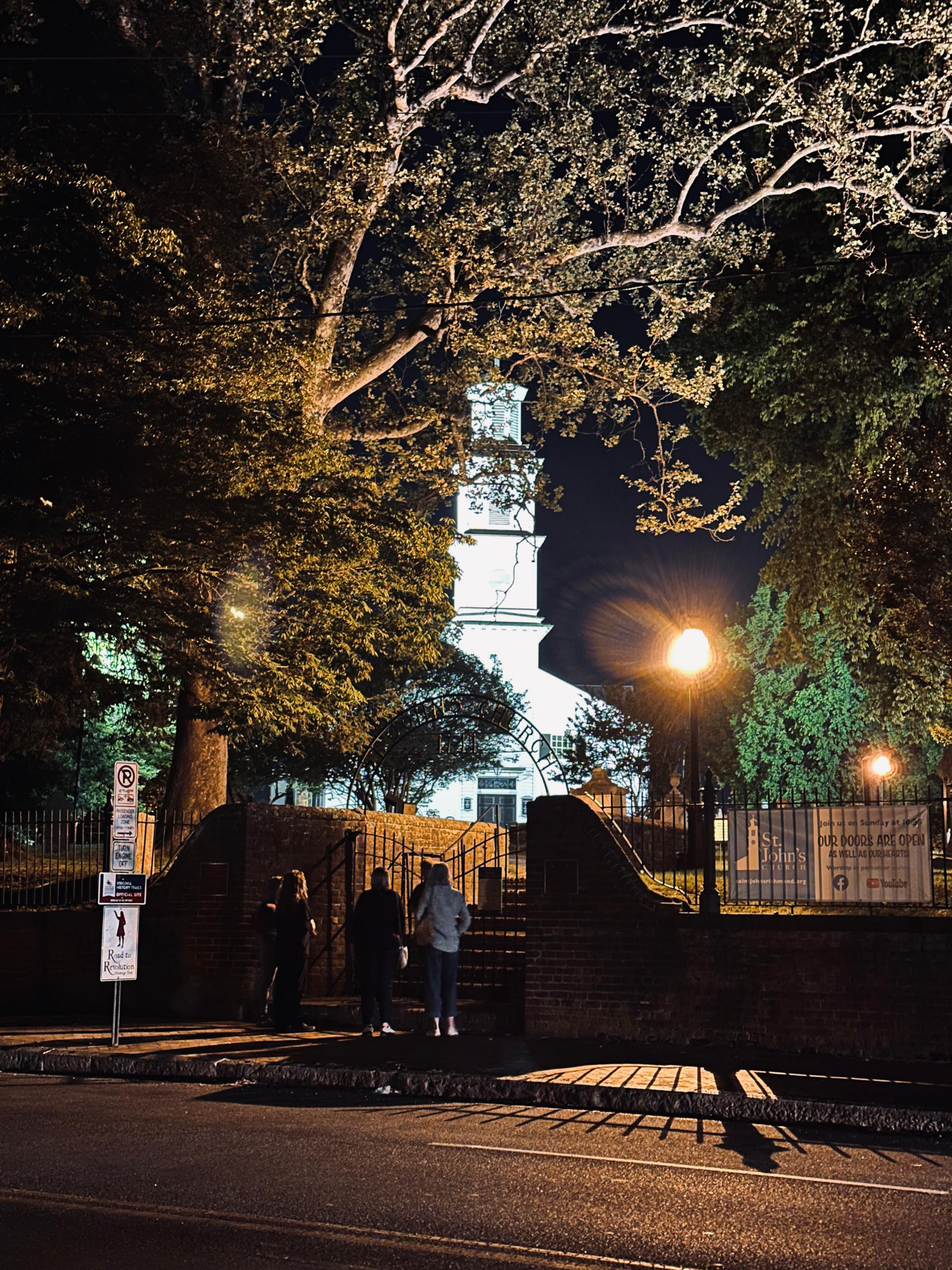
Perched atop Richmond’s Church Hill neighborhood, St. John’s Church is among the city’s most recognizable historic landmarks. Most Virginians know it as the setting of Patrick Henry’s famous “Give me liberty, or give me death!” speech in March 1775. Yet the church’s history extends far beyond that pivotal moment in the American Revolution.
Founded through the efforts of Henrico Parish, the church has witnessed nearly three centuries of Richmond’s development. Its changing architecture reflects the growth of the city, while its historic graveyard preserves the stories of generations of Richmonders. Surviving parish records, architectural surveys, and preservation research offer still more perspectives on the people and events associated with the site.
This collection of research notes brings together historical articles, archival resources, primary documents, and books for those interested in exploring St. John’s Church beyond its most familiar story. The resources are organized by subject, providing several different avenues into the church’s long and varied history.
Parish General History
The history of St. John’s Church is closely intertwined with the development of Henrico Parish, whose origins reach back to the earliest years of English settlement along the James River. As Richmond emerged as a growing commercial center during the eighteenth century, the parish recognized the need for a church closer to the developing town. In 1740, the vestry authorized construction on land donated by William Byrd II, and the building was completed the following year. Originally known by several names, including the Town Church, Upper Church, and Richmond Hill Church, it did not acquire the familiar name St. John’s until the nineteenth century. The congregation subsequently experienced the consequences of the American Revolution, the disestablishment of the Anglican Church in Virginia, the Civil War, and Richmond’s changing social and economic fortunes. Throughout these transformations, St. John’s remained an active place of worship and an important part of the city’s religious and civic life.
Online Resources
- St. John’s Episcopal Church — Parish History — The congregation’s official historical overview, tracing its origins in Henrico Parish through the American Revolution, nineteenth-century developments, and the modern church.
- Library of Virginia — Reopening the Vestry Records of St. John’s Church — An introduction to the surviving parish records, including examples of decisions concerning church construction, cemetery management, and the consequences of the Civil War.
- Encyclopedia Virginia — Richmond During the Colonial Period — Places the church’s founding within the broader development of Richmond as a colonial town and commercial center.
- Historic St. John’s Church — The official website of the historic-site organization, offering information about the church’s history, Revolutionary significance, cemetery, and historical interpretation.
- Encyclopedia Virginia — John Buchanan (1748–1822) — A biography of the Episcopal minister who served as rector of Henrico Parish from 1785 until 1822, providing insight into the church’s post-Revolutionary history.
- St. John’s Church — Vestry Records at the Library of Virginia — Information about the digitized Henrico Parish vestry books, with a link to the original records spanning 1730–1900.
Books & Primary Sources
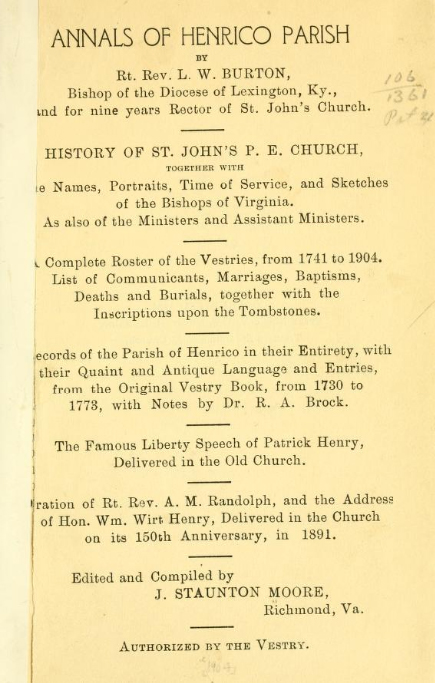
- J. Staunton Moore, L. W. Burton, and R. A. Brock, Annals of Henrico Parish (1904). An extensive early history of the parish containing clergy biographies, vestry records, burial registers, tombstone inscriptions, and other historical material. Particularly valuable for its reproductions of early records, although its interpretations should be considered in their historical context. Read the digitized volume — Library of Congress.
- R. A. Brock, ed., The Vestry Book of Henrico Parish, Virginia, 1730–73 (1874). An important collection of primary records documenting the parish’s administration and development during the colonial period. View the digitized edition — Google Books.
The American Revolution & Second Virginia Convention
St. John’s Church entered the national historical record in March 1775, when delegates gathered there for the Second Virginia Convention. With relations between Great Britain and its American colonies deteriorating, Virginia’s political leaders met outside the regular colonial assembly to consider their next steps. On March 23, Patrick Henry introduced resolutions calling for the organization of Virginia’s militia and delivered the address traditionally remembered for its concluding demand, “Give me liberty, or give me death!” Yet the historical record surrounding the speech is more complicated than its familiar telling suggests. No verbatim transcript survives, and the version commonly recited today was reconstructed decades later by William Wirt. The convention itself also involved substantial debates over colonial rights, military preparedness, and the future of Virginia’s relationship with Britain. Studying these events alongside the later interpretations of Henry’s words reveals both the political significance of the gathering and the development of its enduring historical reputation.
Online Resources
- Historic St. John’s Church — The Second Virginia Convention — A detailed account of the March 20–27, 1775, convention, including its political background, participating delegates, and Henry’s militia resolutions.
- Library of Virginia — Give Me Liberty or Give Me Death — A historical examination of Henry’s speech and the circumstances that prompted his call for military preparedness.
- Encyclopedia Virginia — Patrick Henry’s “Liberty or Death” Speech — Explains the historical uncertainty surrounding the speech’s exact wording and the role of William Wirt in reconstructing it.
- Historic St. John’s Church — The Speech — The traditional text of Henry’s famous address, as preserved through Wirt’s nineteenth-century biography.
- Encyclopedia Virginia — Patrick Henry (1736–1799) — A comprehensive biography covering Henry’s political career before, during, and after the American Revolution.
- Historic St. John’s Church — Patrick Henry — A shorter biography emphasizing Henry’s political achievements and connection to the church.
- Encyclopedia Virginia — “Give Me Liberty or Give Me Death!” — Examines the famous 1876 Currier & Ives depiction of Henry’s speech, including architectural inaccuracies that illustrate how later generations imagined the event.
Books
- William Wirt, Sketches of the Life and Character of Patrick Henry (1817). The foundational nineteenth-century biography through which the familiar version of Henry’s speech entered the historical record. Wirt drew upon recollections of individuals who had witnessed Henry’s oratory, making the book essential to understanding how the speech was preserved and reconstructed. Read the original 1817 edition — Google Books.
- Jon Kukla, Patrick Henry: Champion of Liberty (2017). A thoroughly researched modern biography placing Henry’s political career within the wider context of Revolutionary Virginia. Particularly valuable for understanding the Second Virginia Convention and Henry’s role in the independence movement. Publisher information — Simon & Schuster.
Church Architecture & Physical Evolution
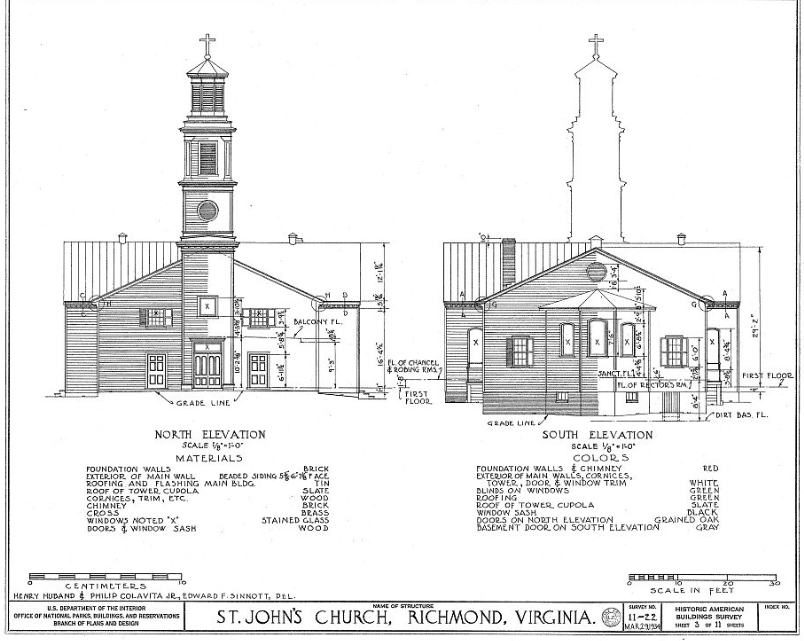
Although St. John’s Church is frequently described as an eighteenth-century landmark, the building visible today represents nearly three centuries of architectural changes. Completed in 1741, the original structure was a relatively modest wooden parish church. An expansion in 1772 created the T-shaped arrangement that accommodated the Second Virginia Convention three years later. Subsequent alterations enlarged the building, extended its nave, added and reconstructed towers, and transformed its sanctuary. Other structures appeared within the churchyard as the needs of the congregation changed. These additions reflect Richmond’s growth, shifting architectural tastes, and evolving approaches to religious worship. They also complicate efforts to imagine precisely what the building looked like during Patrick Henry’s famous address. Historic architectural surveys, measured drawings, and early photographs provide valuable evidence of the church’s physical evolution. Together, these resources demonstrate that the preservation of a historic landmark often involves understanding—and interpreting—many different periods of construction rather than a single original appearance.
Online Resources
- Library of Congress — Historic American Buildings Survey: St. John’s Church — An especially valuable architectural collection containing photographs, measured drawings, and descriptive documentation of the church.
- Virginia Department of Historic Resources — St. John’s Episcopal Church — An overview of the church’s architectural significance and its designation as a National Historic Landmark.
- Society of Architectural Historians — St. John’s Church — A detailed architectural history identifying the building’s principal construction phases, expansions, and later restoration work.
- The Valentine — Building a City: St. John’s Church — A concise examination of the church as one of Richmond’s earliest surviving buildings, presented within the context of the city’s development.
- ArchitectureRichmond — St. John’s Episcopal Church and Churchyard — Discusses the church’s architectural features, its changing appearance, and its relationship with the surrounding cemetery.
Books
- Richard Guy Wilson and contributors, Buildings of Virginia: Tidewater and Piedmont (2002). A scholarly architectural guide containing a detailed examination of St. John’s and its successive construction phases. The relevant material is also available through the Society of Architectural Historians. St. John’s Church — SAH Archipedia.
- Mary Wingfield Scott, Old Richmond Neighborhoods (1950). An important work documenting Richmond’s historic neighborhoods, including the development of Church Hill and the architectural changes surrounding St. John’s. Read the expanded digital edition.
- Paul S. Dulaney, The Architecture of Historic Richmond (1968). A significant architectural survey of Richmond’s historic buildings, developed from preservation research conducted during the 1960s. Library of Virginia — Background on the architectural survey.
The Graveyard & Famous Burials
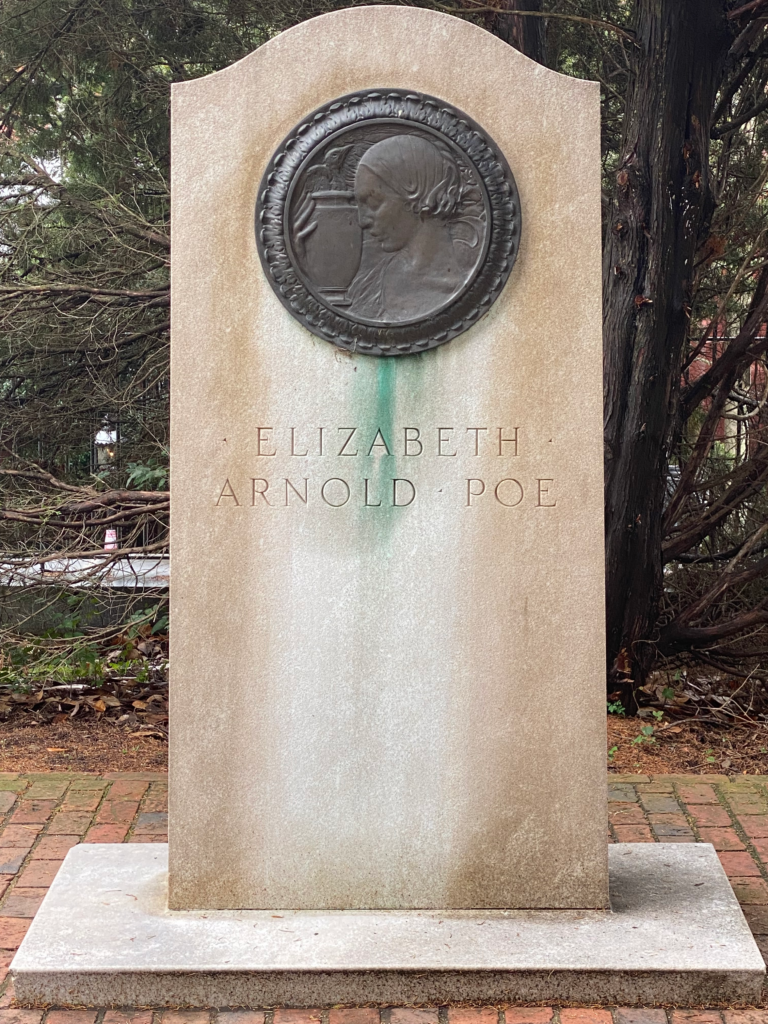
The historic graveyard surrounding St. John’s Church preserves a remarkable cross-section of early Richmond society. Burials began during the colonial period, and in 1799 the city purchased adjoining land to establish what became Richmond’s first public cemetery. By 1820, the burial ground had become so crowded that church officials complained of graves disturbing earlier interments. Today, approximately 400 gravestones remain above ground, although modern investigations suggest that several thousand people may have been buried within the cemetery. Among those associated with the grounds are Declaration of Independence signer George Wythe, Revolutionary officer Edward Carrington, Virginia governors John Page and James Wood, and Elizabeth Arnold Poe, the mother of Edgar Allan Poe. Yet the cemetery’s significance extends beyond its prominent residents. Its surviving markers, incomplete records, and unmarked burials provide glimpses into the lives of ordinary Richmonders, including families, children, immigrants, and individuals whose stories have largely disappeared from the historical record.
General Cemetery Resources
- Historic St. John’s Church — Historic Graveyard — The primary introduction to the cemetery’s history, notable burials, preservation efforts, and modern investigations.
- Historic St. John’s Church — Frequently Asked Questions — Identifies several prominent individuals buried in the churchyard and addresses common misconceptions, including the fact that Patrick Henry is not buried there.
- City of Richmond — Cemeteries — Municipal information useful for understanding St. John’s place among the city’s historic burial grounds.
- Library of Virginia — Richmond City Microfilm Records — An archival inventory that includes historical cemetery documentation, burial records, and tombstone inscriptions relating to St. John’s.
Notable Burials & Biographical Research
- George Wythe — Library of Virginia — A detailed biography of the influential Revolutionary-era jurist, Declaration signer, and teacher of Thomas Jefferson. Wythe died in 1806 and was buried at St. John’s.
- Edward Carrington — Library of Virginia — Examines the life of the Revolutionary War officer whose grave became associated with a tradition surrounding Patrick Henry’s 1775 speech.
- Elizabeth Ambler Brent Carrington — American Battlefield Trust — An account of the Richmond philanthropist and advocate for women’s education who is believed to be buried beside her husband, Edward Carrington, although her grave remains unmarked.
- James Wood — Library of Virginia — A biography of the Revolutionary War officer and Virginia governor buried in the historic churchyard.
- John Dove — Library of Virginia — The story of a prominent Richmond physician and influential Freemason whose 1876 funeral culminated in his burial at St. John’s.
Book
- J. Staunton Moore, L. W. Burton, and R. A. Brock, Annals of Henrico Parish (1904). Contains extensive burial registers and transcriptions of historic tombstone inscriptions, making it particularly useful for identifying individuals and families associated with the cemetery. Read the digitized volume — Library of Congress.
Parish Records, Archaeology & Cemetery Preservation
Much of what historians know about St. John’s Church survives through the combination of written records and physical evidence. The Henrico Parish vestry books, beginning in 1730, document church administration, construction projects, financial decisions, assistance to the poor, property disputes, and other aspects of community life. These records preserve details that might otherwise have disappeared, including the 1740 decision to construct a church on Richmond Hill and the growing concerns over cemetery overcrowding in 1820. Modern preservation efforts have introduced additional methods of investigation. Ground-penetrating radar surveys of the churchyard have identified evidence consistent with numerous unmarked burials, suggesting that the surviving gravestones represent only a fraction of those interred. Meanwhile, changing cemetery boundaries, building expansions, weathering, and earlier burial relocations complicate efforts to reconstruct the original landscape. Examining these sources together offers insight not only into the church’s history but also into the methods and challenges of historical research itself.
Online & Archival Resources
- Library of Virginia — Reopening the Vestry Records of St. John’s Church — Introduces the parish’s surviving records and highlights their value for understanding eighteenth- and nineteenth-century Richmond.
- Historic St. John’s Church — Graveyard Research and Preservation — Details ongoing gravestone conservation and archaeological investigation, including ground-penetrating radar surveys.
- Richmond and Historic St. John’s Church, Then & Now — An interactive StoryMap by Brian Whiting exploring the church’s history, cemetery landscape, and geophysical investigations.
- Library of Virginia — St. John’s Parish Records — The congregation’s history page provides a link to the archival collection of historic parish records.
- Library of Virginia — Richmond City Cemetery and Burial Records — An inventory of surviving municipal records that can assist research into historic burials and graveyard inscriptions.
- Library of Congress — Historic American Buildings Survey — Measured architectural drawings and historic photographs that complement the parish records and help document the building’s physical changes.
Books & Primary Sources
- R. A. Brock, ed., The Vestry Book of Henrico Parish, Virginia, 1730–73 (1874). An important published transcription of early vestry records, documenting decisions concerning the parish and the construction of the Richmond church. Digitized edition — Google Books.
- J. Staunton Moore, L. W. Burton, and R. A. Brock, Annals of Henrico Parish (1904). Combines historical narrative, transcribed records, and genealogical material, providing a useful companion to the original parish documents. Digitized edition — Library of Congress.
St. John’s, Church Hill & Historic Preservation
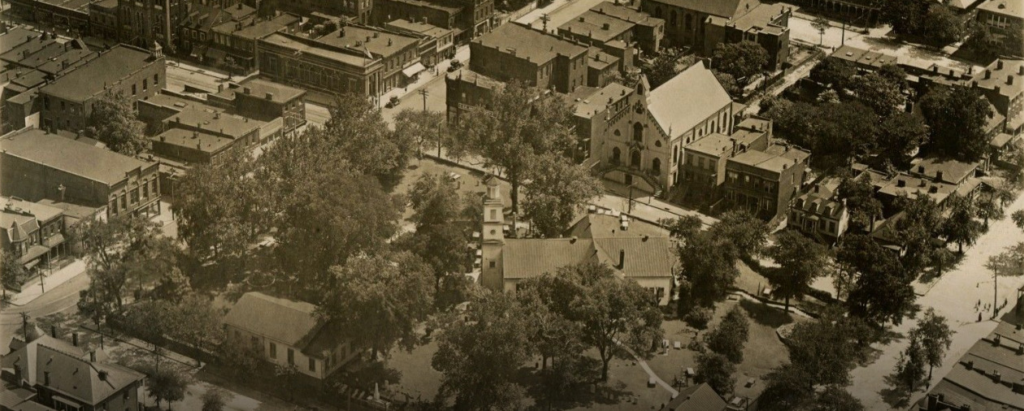
The history of St. John’s Church cannot be separated from the development of the neighborhood that surrounds it. The church was constructed on elevated ground overlooking the growing settlement along the James River, and its presence eventually gave Church Hill its enduring name. Residential development gradually spread around the landmark, producing the mixture of Federal, Greek Revival, Italianate, and other architectural styles that characterize the neighborhood today. During the twentieth century, however, deterioration and demolition threatened much of Richmond’s historic architectural fabric. Preservationists, including the influential researcher Mary Wingfield Scott, helped draw attention to the significance of these surviving buildings. The establishment of Richmond’s first local Old and Historic District around St. John’s in 1957 became an important milestone in the city’s preservation movement. The church consequently represents more than an individual historic structure: it remains an anchor for one of Richmond’s most distinctive neighborhoods and an enduring symbol of efforts to preserve the city’s architectural heritage.
Online Resources
- Virginia Department of Historic Resources — St. John’s Church Historic District — An overview of Church Hill’s architectural development, historic character, and twentieth-century preservation efforts.
- City of Richmond — Old and Historic District Guidelines — Municipal preservation guidelines providing background on Richmond’s historic districts, including the creation of the St. John’s district.
- Society of Architectural Historians — Church Hill — An architectural survey of the neighborhood, its historic structures, and its development around St. John’s Church.
- The Cultural Landscape Foundation — St. John’s Church Historic District — Examines Church Hill as a historic cultural landscape, emphasizing the relationship between its architecture, street patterns, topography, and public spaces.
- Library of Virginia — Mary Wingfield Scott — A biography of one of Richmond’s most influential architectural historians and preservation advocates.
- Church Hill Association — Explore Historic Church Hill — A neighborhood-oriented resource with additional information about Church Hill’s history, architecture, and contemporary community.
Books
- Mary Wingfield Scott, Old Richmond Neighborhoods (1950). A foundational study of historic Richmond neighborhoods, documenting buildings and streetscapes that were already facing threats from demolition and redevelopment. Particularly useful for understanding Church Hill before its later restoration efforts. Expanded digital edition.
- Richard Guy Wilson and contributors, Buildings of Virginia: Tidewater and Piedmont (2002). A scholarly architectural guide that situates St. John’s Church and the surrounding neighborhood within the larger history of Virginia’s built environment. Society of Architectural Historians — St. John’s Church.